
Trading Basics
Spot vs Futures Trading: What's the Difference?
By CashQueen Global / QUEENX K & R GLOBAL ·
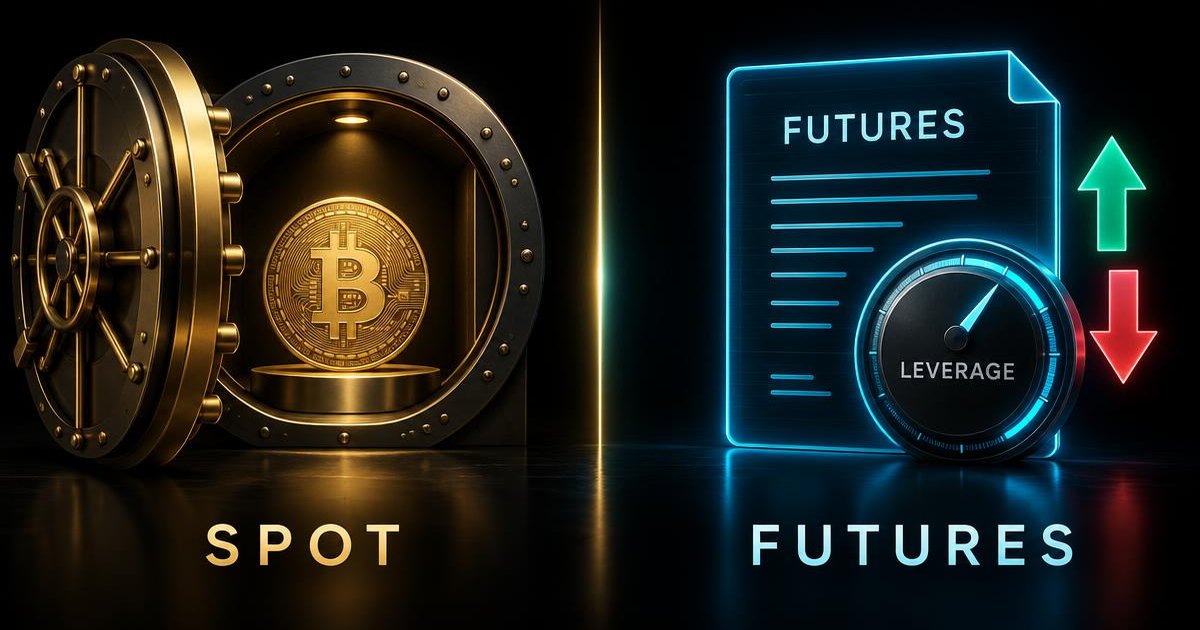
Cryptocurrency can be traded through different types of markets. Two terms beginners commonly come across are spot trading and futures trading. They work differently and carry different risks, so understanding the difference is important before using any trading platform or automated trading tool.
What Is Spot Trading?
Spot trading generally involves buying or selling an asset at the current market price. Ownership and settlement of the underlying asset happen according to the exchange's rules.
Example: A person buys $100 worth of BTC on a spot market. The person holds the purchased BTC in the exchange account or transfers it to a compatible wallet, depending on the exchange and transaction.
Exact settlement and custody arrangements vary by platform.
What Is Futures Trading?
Futures trading involves contracts whose value is based on an underlying asset, such as BTC. The trader generally does not buy the underlying cryptocurrency in the same way as a spot purchase — they hold a contract position instead.
Depending on the contract and platform, futures can allow traders to take long positions (which gain if the price rises) or short positions (which gain if the price falls). Either can also lose.
Spot vs Futures — Simple Comparison
| Feature | Spot Trading | Futures Trading |
|---|---|---|
| What is traded | The cryptocurrency itself (for example BTC or ETH). | A contract whose value is based on an underlying cryptocurrency. |
| Ownership / underlying asset | You generally own the purchased asset, held according to the exchange's custody rules or transferred to a compatible wallet. | You generally hold a contract position, not the underlying cryptocurrency. |
| Ability to go long | Yes — by buying the asset. | Yes — by opening a long position. |
| Ability to go short | Not directly in a basic spot purchase. | Often yes — by opening a short position, depending on the contract. |
| Leverage | Not used in basic spot trading. | Commonly available; increases exposure relative to your margin. |
| Liquidation risk | Not applicable to a basic unleveraged spot purchase. | Yes — leveraged positions can be closed by the exchange if margin is insufficient. |
| Contract / funding considerations | None for a basic spot purchase. | Contract specifications, margin rules and (for perpetual contracts) funding payments. |
| Complexity | Generally simpler to understand. | Generally more complex. |
| Main risks | Price falls, fees, volatility and platform risk. | All spot risks plus leverage, liquidation, funding and faster potential losses. |
Exact features vary by exchange and contract.
What Is Leverage?
Leverage lets a trader open a position larger than their own margin (the funds they put up) would normally allow. It increases exposure relative to the trader's margin and can magnify both gains and losses.
Illustrative example only: with $100 of margin at 5× leverage, a trader controls a $500 position. A 10% price move against the position would equal roughly $50 — half of the trader's margin — before fees and funding.
Leverage is optional on many platforms, and it is not something you need to use.
What Is Liquidation?
If a leveraged futures position moves sufficiently against the trader and the required margin is no longer maintained, the exchange may close the position according to its liquidation rules. Liquidation can result in significant loss, including loss of the margin committed to that position.
What Is Funding in Futures Trading?
Some perpetual futures contracts (futures with no expiry date) use a funding mechanism: periodic payments exchanged between long and short positions. Depending on market conditions, a position may pay or receive funding.
Funding rates change over time and vary by platform and market conditions. Funding should not be treated as a guaranteed cost or a guaranteed source of income.
Can You Make Money With Spot Trading?
Spot trading can result in gains or losses depending on the asset's price movements and transaction costs such as fees. There is no guaranteed outcome.
Can You Make Money With Futures Trading?
Futures trading can result in gains or losses, and leverage can increase the size of both. Futures trading does not guarantee profit.
Which Is Better: Spot or Futures?
Neither is simply "better." They are different trading instruments with different characteristics, risks and levels of complexity. Understand the mechanics and risks of each before deciding what may be appropriate for your own circumstances.
Spot vs Futures for Beginners
Some educational points beginners should understand:
- Learn how the market works.
- Understand fees.
- Understand leverage before using it.
- Understand liquidation.
- Understand funding where applicable.
- Start by learning rather than assuming automated trading eliminates risk.
- Understand the exchange's rules.
- Never risk money you cannot afford to lose.
- Use appropriate account security.
This is general education, not personalised financial advice.
How Does This Relate to UTrading AI?
UTrading AI supports trading functionality involving spot and futures markets where supported by the platform and the connected exchange. The exact markets, contracts, leverage options and exchange features available can change, so verify current supported features before trading.
To learn more, read our guide to UTrading AI and automated crypto trading and our beginner's guide to API connections in crypto trading.
Important Risks of Futures Trading
Leverage risk
Leverage magnifies the effect of price moves on your margin, in both directions.
Liquidation
A position can be closed by the exchange if required margin is no longer maintained, which can mean significant loss.
Market volatility
Crypto prices can move sharply and quickly, sometimes within minutes.
Funding costs
Perpetual contracts may involve funding payments that change with market conditions.
Fees
Trading, funding and other fees reduce results and add up over many trades.
Slippage
Orders may fill at a different price than expected, especially in fast markets.
Position sizing
Positions that are too large relative to your account increase the impact of each move.
Emotional / behavioural risk
Fear, greed and overconfidence can lead to poor decisions.
Exchange / platform risk
Exchanges can have outages, rule changes or other operational problems.
Technical / system risk
Connectivity issues, software errors or misconfiguration can affect trades.
Frequently Asked Questions
What is spot trading in crypto?
What is futures trading in crypto?
What is the difference between spot and futures?
Can you lose more money with futures trading?
What is leverage?
What is liquidation?
Can you short cryptocurrency with futures?
What is funding in crypto futures?
Is futures trading suitable for beginners?
Can automated trading eliminate trading risk?
Final Takeaway
Spot trading generally involves the cryptocurrency itself, while futures trading involves contracts based on it — often with leverage, short positions, liquidation rules and funding. Understanding the mechanics, fees, leverage, liquidation and other risks is important before trading either.
Join the CashQueen Global Community
Questions about getting started? Join our Telegram community or chat with us on WhatsApp.
About CashQueen Global
CashQueen Global is the public-facing brand of QueenX K & R Global, led by Caroline Onobrenufe, publicly known as CashQueen.
The brand focuses on crypto education, mentorship, awareness and guidance around crypto tools, as well as AI and digital business education. CashQueen Global also provides promotion, education and coaching around the UTrading software. UTrading is a separate trading software/platform. CashQueen Global is not a cryptocurrency exchange and does not hold, custody or control users' cryptocurrency funds.